how the world leading psychologist in compassion and mindfulness research would teach me about being human. a personal summary of the congress “attachement and
trauma”
I love
listening. And I am more than intrigued by the concepts behind compassion and
mindfulness as interventional methods in psychotherapy. Therefore I ended up,
lowering the age limit and seeking for responses in the middle of 1200 people,
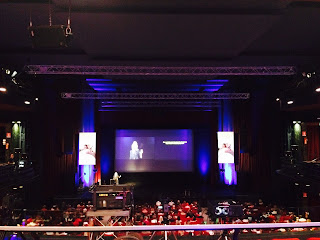
attending a conference exactly asking this question: how does attachment work
and how can we use mindfulness and compassion in therapeutically contexts with
humans who have been affected by life so hard, that feeling love and joy is one
of the most challenging tasks they’d find for their lives.
Many people
are asking me now, what I've learned. Conferences are confined spaces,
collecting masses of potential but hiding it behind scientific borders. As we
were talking about humans, we should also share these thoughts to humans. I’d
love that each of the 1200 attendees would spread his/her ideas and thoughts
somewhere. It might happen in many ways - and here is mine.
It's not
possible to sum up this massive inspiration and motivation, the complexity of
thoughts and dedication to research I would be able to observe, but here are
some of my most recent thoughts and feelings. I want to adjust, very seldom in
my life I felt so much connected and supported in my way of thinking like in
these days.
me, myself and a mainstream called mindfulness
 We live in a
culture which prays the individualistic, yet, the egoistic. People associate
'mindfulness' to a status of acting superior. But, mindfulness has nothing to
do with yoga retreats in India and hipster vegan food. It has nothing to do
with fleeing from this world and hiding in rooms covered by the smell of
incense sticks.
We live in a
culture which prays the individualistic, yet, the egoistic. People associate
'mindfulness' to a status of acting superior. But, mindfulness has nothing to
do with yoga retreats in India and hipster vegan food. It has nothing to do
with fleeing from this world and hiding in rooms covered by the smell of
incense sticks.
“It’s mindfulness, mindfulness, mindfulness
everywhere. And then: compassion, compassion, compassion. People are talking so
much about it, that they can’t live it” (Jon Kabat-Zinn)
Mindfulness
is mainstream. It became popular due to neuroscience studies, which showed how
the brain transforms once people start to meditate. And who – in our society of
high-achievers – is not looking for a perfect method to rewire the brain
towards a supercomputer. But mindfulness is more than that and life itself
should become the actual meditation practice.
“Mindfulness is not an invitation to become more and
more egocentric, it is actually the other way around: do not act self-centered,
but feel the correlational towards this planet and all its beings.” (Jon
Kabat-Zinn)
Daniel
Siegel used an even better word for it: MWe,
a combination of “me” and “we” to describe us individuals as a part of a
large system we call: humanity. Yes, we might be separated by our skins, but we
are interconnected by our breathing and sharing the same rhythm of heartbeat.
Research is supporting his model of defining happiness as a result of feeling
related to a group of people, and being a part of them.
we are all together in this
‘If everyone
cares for himself then nobody is alone.’ I’ve heard this sentence in a group of
dancers – means: a group in which people are associated with sharing moments of
touch to each other. When this person said this sentence, everyone around would
applause and appreciate the saying. I sat in the middle of this group and were
about to cry. I don’t want to be the only one to care about myself – I want to
be cared and protected by others. In addition to that: so many times we
experience, that it is much easier to care about others than for you. Why not
use this potential?
 Yes, responsibility is risky. We can feel absolute
responsible and meaning the best and we might achieve the worst we can imagine.
Yes, responsibility is connected to failure, guilt, shame and all that ugly
stuff modern society tries to prevent us from. But think about it: how poor
would your life be, if you could never say or feel sorry? Shame is, according
to Kathy Steele, a support for social structures in society which teaches us
the borders and limitations we have to keep up in order to guarantee safety.
Those who do not feel shame are sociopaths. Yes, responsibility sometimes
forces us to cross the borders of what we consider to be accurate.
Yes, responsibility is risky. We can feel absolute
responsible and meaning the best and we might achieve the worst we can imagine.
Yes, responsibility is connected to failure, guilt, shame and all that ugly
stuff modern society tries to prevent us from. But think about it: how poor
would your life be, if you could never say or feel sorry? Shame is, according
to Kathy Steele, a support for social structures in society which teaches us
the borders and limitations we have to keep up in order to guarantee safety.
Those who do not feel shame are sociopaths. Yes, responsibility sometimes
forces us to cross the borders of what we consider to be accurate.
During her speech, Pat Ogden would show a therapy
video in which she is holding the hand of a client who is traumatized from war
and uses his right hand, seeking for touch. She asks him what he would like to
do with the hand and he is responding that he would need her to hold it. So she
did. Watching this, someone in the audience stands up and asks: "How could
you touch the client? We are not supposed to do that in therapy."
Ogden: "How could I not? Sometimes
therapy comes to the point where it starts to be about humanity."
the most basic
human instinct called compassion
No one ever has to learn compassion. We are all born
with the intuition to care and feel for and with other humans. Using it in
therapy is just a friendly reminder for our patients how care and listening can
work, as these people are often so traumatized from the fact of not having
experienced enough of it. Compassion is correlated to another aspect: courage!
In order to be compassionate, we must dedicate ourselves to the fact that “our species is able to create good things
and embrace love and care, but also works in a destructive way, starting wars,
torturing people, coming crimes.” (Paul Gilbert) The acceptance of this
suffering requires a high amount of courage and dedication. It expects us to
decrease illusion, leave the hippie status of believing everything is covered
in flowers. Yes, this world is good, and sometimes it is really bad. Both are
part of our existence and need to be seen.
We are all
wired to connect, shaped for love and build to take over the responsibility
about ourselves, but also about everyone and everything surrounding us. Care
and protection are infinity human instincts and the key towards happiness and
love.
This is what
I really have to share in these lines: Dedicate yourself, love, fail and fall,
love even harder.
Mindfulness
is everywhere, such as compassion. If there is something I really want to
achieve now, it’s encouraging people to act responsible, feel interconnected
and throw themselves into this adventure of falling and flying we call ‘life’.
“People are aiming so much towards a higher and
greater status of so called mindfulness. But this concept teaches us to live
the present moment. Now. You could die after each breath. Focus on what is now
and enjoy it.” (Jon Kabat-Zinn)
 Psychologie im Weltraum ist ziemlich wichtig: Astronauten leiden in Langzeitmissionen unter Isolation, sensorischer Deprivation oder unter kulturellen Differenzen
in ihrer Gruppe. Außerdem ist es wichtig zu schauen, welcher
Charaktertyp überhaupt für eine Reise zum Mars taugt und wie man eine
Gruppe – egal ob Astronauten oder Mission Control – dafür trainiert. Das
herauszufinden, das ist mein Job!
Psychologie im Weltraum ist ziemlich wichtig: Astronauten leiden in Langzeitmissionen unter Isolation, sensorischer Deprivation oder unter kulturellen Differenzen
in ihrer Gruppe. Außerdem ist es wichtig zu schauen, welcher
Charaktertyp überhaupt für eine Reise zum Mars taugt und wie man eine
Gruppe – egal ob Astronauten oder Mission Control – dafür trainiert. Das
herauszufinden, das ist mein Job! Darüber hinaus entwickele ich eine Studie, die genau diese Hypothesen, speziell in unseren Teams, überprüft. Welche
Faktoren verbinden Menschen in einer Gruppe, und was trägt dazu bei,
dass eine Gruppe nicht miteinander harmoniert? Was können wir aus
unseren vergangenen Missionen lernen? Meistens arbeite ich mit
Fragebögen, die am Ende zu den langen Zahlreihen führen. Psychologie
besteht nämlich zu einem sehr großen Teil aus Statistik! Auf den ersten
Blick wirkt das so, als würden wir die Komplexität des Menschen in ein
vorpilotiertes Raster einspeisen wollen, aber so ist das nicht! Die
Arbeit mit Fragebögen erlaubt uns, von einer großen Anzahl von Menschen,
Gedanken und Tendenzen zu erfassen und genau diesen im Training und in
der persönlichen Begegnung nachzuspüren.
Darüber hinaus entwickele ich eine Studie, die genau diese Hypothesen, speziell in unseren Teams, überprüft. Welche
Faktoren verbinden Menschen in einer Gruppe, und was trägt dazu bei,
dass eine Gruppe nicht miteinander harmoniert? Was können wir aus
unseren vergangenen Missionen lernen? Meistens arbeite ich mit
Fragebögen, die am Ende zu den langen Zahlreihen führen. Psychologie
besteht nämlich zu einem sehr großen Teil aus Statistik! Auf den ersten
Blick wirkt das so, als würden wir die Komplexität des Menschen in ein
vorpilotiertes Raster einspeisen wollen, aber so ist das nicht! Die
Arbeit mit Fragebögen erlaubt uns, von einer großen Anzahl von Menschen,
Gedanken und Tendenzen zu erfassen und genau diesen im Training und in
der persönlichen Begegnung nachzuspüren.


