transit! is it geographical? physical? I started thinking - and ended up transitting - from emotions to virtual worlds.
first of all –
this text has no real language as everyone was encouraged to use the language
he/she prefers. That might be the first step towards an understanding of
transitory spaces. We leave defined concepts of using only one language per
article and start building our pathways to explore the more unprecise idea of
spaces in between.
Thinking of
transit helped me to understand that ‘transit’ might describe one of my life’s
most important experiences. I’ve been born in transit. My parents emigrated
from Romania to East-Germany, and short after my birth Germany would celebrate
the reunification. I was raised between two languages and the values of two
differing cultures. Also this blog could be seen as a transit space, trying to
build up bridges between topics, which usually do not touch each other. Dance
meets human spaceflight, plus education and mindfulness. It might be the fact
that transit is overall in my life that encouraged me to explore further. The
following stories share some perspectives on transit – physical, geographical,
but also emotional and virtual transit.
Pia, 22 – „die
Welt ist für mich kleiner geworden“
“Also, Düsseldorf, Cottbus, Berlin, Amsterdam,
Barcelona – das war so in den letzten zwei Wochen.” Pia muss ein bisschen
überlegen, wenn sie ihre Stationen aufzählt. Gerade ist sie hier, nicht lange,
ein paar Sachen regeln. Dann geht es weiter für sie. Es ist kein Urlaub,
sondern ihre engagierte Arbeit, die unzählige Treffen mit Projektgruppen
voraussetzt, die Pia zu einem Menschen
werden lässt, der viel Zeit an sogenannten ‚Nichtorten‘ verbringt. Orte, die
oft keine Identität haben, so wie Bahnhöfe oder Autobahnen und die man
eigentlich am liebsten so nutzt, dass man sie schnellstmöglich wieder verlassen
kann. „Es gibt kleine Gewohnheiten, die ich an solchen Orten habe. Im Bus gibt
es einen Lieblingssitz, wo ich gerne sitze. Wenn der frei ist, dann freue ich
mich. Und es sind Details, die ich mit Orten verbinde – am Essener Bahnhof weiß
ich, wie die Lichter einfallen, daran erinnere ich mich dann.“
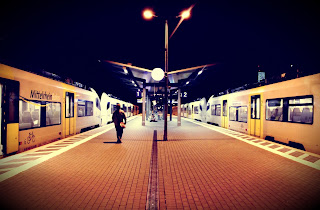 Zum Abitur hat Pia ein Fahrtkostenkonto geschenkt
bekommen. Und sie ist jemand, der seinen Rucksack nach einer selbst
entwickelten „Standardpackordnung“ packt – und zwar in der letzten Minute.
Jemand, der weiß, dass die Busstrecke nach Berlin von Sonntag auf Montag echt
nervig ist. Und jemand, der das Wort „Transit“ nach eigenen Angaben nur sehr
selten im Wortschatz benutzt. „Ich fahre viel Bus oder Bahn und dann arbeite
ich oft dort an meinem Laptop. Oder ich schlafe. Ich empfinde die Zeit
unterwegs selten als Transit, ich bin daran gewöhnt.“
Zum Abitur hat Pia ein Fahrtkostenkonto geschenkt
bekommen. Und sie ist jemand, der seinen Rucksack nach einer selbst
entwickelten „Standardpackordnung“ packt – und zwar in der letzten Minute.
Jemand, der weiß, dass die Busstrecke nach Berlin von Sonntag auf Montag echt
nervig ist. Und jemand, der das Wort „Transit“ nach eigenen Angaben nur sehr
selten im Wortschatz benutzt. „Ich fahre viel Bus oder Bahn und dann arbeite
ich oft dort an meinem Laptop. Oder ich schlafe. Ich empfinde die Zeit
unterwegs selten als Transit, ich bin daran gewöhnt.“
Die Anonymität von Nichtorten berührt Pia wenig: „Es
hängt davon ab, wie empfindlich ich selbst gerade bin. Dann reagiere ich ganz
anders auf die Menschen, die in der Bahn dicht neben mir sitzen.“ Aber ja,
Nichtorte sind häufig Räume, in denen Gespräche verschwinden, obwohl die
kontroversesten Lebensgeschichten nebeneinander am Fahrtkartenautomaten
auftauchen. Obdachlose, die den öffentlichen Raum als privaten Raum nutzen und
intime Handlungen, wie das Zähneputzen in den Schauraum der Öffentlichkeit
transportieren. Und dann ist da die Frage, ob wir nicht langsam alle so werden
– mehr und mehr im Transit lebend, verkabelt und verbunden, in Jogginghosen in
Fernbussen und via Skype am Flughafen.
„Wenn
ich das mit meinen Großeltern vergleiche, habe ich eine ganz andere Wahrnehmung
von Distanz. Die planen monatelang einen Urlaub. Ich denke mir: Oh, morgen
musst du in Hamburg sein.“
Andrea, 30 – “plane tickets are my bookmarks”
I’m meeting Andrea at a
bar. She is in transit. Friday – Sunday: New York City. Next week: Australia.
“It’s just a 7 hours flight, and it’s direct, so no problem!” she says. Further,
she still needs to pack her stuff. Tonight.
“I travel every weekend to a different country in Europe. 2-8 hours
transit per day, every Friday, Saturday and Sunday, depending where I go.
Previously in Australia I travelled 900km one way to work in the desert, so I
am used to these distances.” For Andrea,
transit means the time and location between work or home and her destination. A
place she associates with words such as “recharging”.
Time in transit is however
long it takes to go from starting point to final destination. It's usually
filled with private relaxation with music in headphones and games/movies work
or on planes, after takeoff, by sleep. “I normally expect internet access in
all forms of transit now for almost the whole time (in air wifi, train wifi,
bus wifi, personal data roaming).” For many of us, transit is associated with
anonymity and constant solitude, but due
to technological innovations, we are not alone, even during transit:
“Anonymity doesn't play a role in transit anymore unless you drive or cycle or
walk - all tickets are pretty linked to an official ID and your movement is
trackeable.”
“Home is where I store my things and don't have to worry about what I'm
wearing and what others think or being attacked or surprised.”
 Public spaces are anywhere
outside a private home or hotel. “Private spaces would be somewhere you can relax
and not wear pants. Public spaces can't be private except for shared spaces,
like hotel rooms which are used by different people - in all other cases
there's always a chance of someone approaching you and therefore outside of
locked private residences where you could sleep without fear of being touched,
I'd consider all spaces public.”
At the end of the year,
Andrea usually draws a map of all her destinations. I am certain; most of us
would fail doing this for the city they live in.
Public spaces are anywhere
outside a private home or hotel. “Private spaces would be somewhere you can relax
and not wear pants. Public spaces can't be private except for shared spaces,
like hotel rooms which are used by different people - in all other cases
there's always a chance of someone approaching you and therefore outside of
locked private residences where you could sleep without fear of being touched,
I'd consider all spaces public.”
At the end of the year,
Andrea usually draws a map of all her destinations. I am certain; most of us
would fail doing this for the city they live in.
Pedro, 33
“values and ideals changing and me trying to keep up.
New values showing up and turning life upside-down.”
“do you like it?”
“The short answer is: yes I do.”
Transit –
we usually associate it with geographical places, points on a map. But transit
also can happen between your synapses and your thoughts. We all might have
experienced periods of time in our lives in which we realized that routines,
thoughts and values are about to change. Some of us might be afraid of change –
as we don’t know where transit is guiding us. Maybe, we just need to listen up
and follow…
 “Humm, looking back now, I
think it started with the problems in the relationship. Even though I didn't
"see" it at the time, I was slowly getting depressed and didn't know
what was going on. Then I became officially depressed and learned - still
learning - from it. I would say: I like it, but sometimes it was and is hard as
hell.
With all this, many things
changed and I eventually left my job and more recently the relationship. I
don't say that there is a direct relationship... but it is the sequence of
events. Earlier it would have been "just life", but at 33 years old I
thought I had life figured out already. So now all this is "new" and
"not me" and "people don't just do this" and it's hard to
accept sometimes. That's why it feels like transit: stuff happening, moving all
the time.
Recently I learned what it
is to be sad. You may laugh at this, but I don't remember ever being (just)
sad. Well, I laugh at it myself. It is painful, but it is nice to "know it"
and "learn it" and "feel it".
“Humm, looking back now, I
think it started with the problems in the relationship. Even though I didn't
"see" it at the time, I was slowly getting depressed and didn't know
what was going on. Then I became officially depressed and learned - still
learning - from it. I would say: I like it, but sometimes it was and is hard as
hell.
With all this, many things
changed and I eventually left my job and more recently the relationship. I
don't say that there is a direct relationship... but it is the sequence of
events. Earlier it would have been "just life", but at 33 years old I
thought I had life figured out already. So now all this is "new" and
"not me" and "people don't just do this" and it's hard to
accept sometimes. That's why it feels like transit: stuff happening, moving all
the time.
Recently I learned what it
is to be sad. You may laugh at this, but I don't remember ever being (just)
sad. Well, I laugh at it myself. It is painful, but it is nice to "know it"
and "learn it" and "feel it".
Conny, 29 – “when I speak another language, my voice and
my personality change.”
The term “emotional transit” can mean different things to different people. For me, it describes the sense of no longer feeling
at home, or even at ease, where I live.
On the surface of things, I should be fine. I
live in my hometown, among people I have
known my entire life. And I think that is
exactly my problem.
For six years I used to live in England, and I have
always considered myself a native English-speaker. Moving back to Germany a few
years ago was a necessity at the time,
and a mistake in retrospect. Ever since I
came home, I’ve been living with the
feeling that I do not belong here
anymore. What I initially put down to
reverse culture shock and reluctance to leave the UK, did not go away in the
three years I have been back now. I spent
most of my adult life so far in
English-speaking countries, most of which had slightly different social
patterns, cultures, and mentalities. Even as a native German-speaker, who had
Advanced German in her Abitur, I still
find it hard to speak German again. I
feel that English is my true language. When I’m forced to read or translate something in German
it always sounds wrong to my ear because I think the English version expressed
it better.
English has become my
default language. They say that you’ve truly
mastered a language when you dream in it. However, I think you’ve really
switched languages when it’s the first language that comes to mind, even first
thing in the morning. If you can have a full conversation without properly
waking up then, yes, I do believe that whatever language you’re using is the
primary one on your mind. And that’s fine when the language you speak and the
language you’re surrounded by match. But for me, the fact that I think and work
in a different language to those around me can create everything from amusement
to hostility.
 The longer I’m in Germany the stronger I feel that I do not
belong here. And try as I might to re-integrate myself, I still end up feeling
like a stranger in my own country. Home is not “Sweet Home” when you don’t
belong. It has given me time to think, though, about the sort of culture and
mentality I’d like to be surrounded by in an ideal world. While I was living
abroad, I accepted the emotional transit from my own culture and language to
another as a fact of life without conscious thought. Now I realise how
momentous, deep-reaching and profound it really is. What I have come to realise
and believe is that just like some people are born with the wrong gender or
body, others are born in the wrong country and language. And that feeling, for
me at least, has never been as strong as it is now that English is not my
everyday language anymore.
The longer I’m in Germany the stronger I feel that I do not
belong here. And try as I might to re-integrate myself, I still end up feeling
like a stranger in my own country. Home is not “Sweet Home” when you don’t
belong. It has given me time to think, though, about the sort of culture and
mentality I’d like to be surrounded by in an ideal world. While I was living
abroad, I accepted the emotional transit from my own culture and language to
another as a fact of life without conscious thought. Now I realise how
momentous, deep-reaching and profound it really is. What I have come to realise
and believe is that just like some people are born with the wrong gender or
body, others are born in the wrong country and language. And that feeling, for
me at least, has never been as strong as it is now that English is not my
everyday language anymore.
Mike, 29 – „Es
hat nie eine Zeit gegeben, in der alle Menschen in derselben Realität gelebt
haben.“
Gibt es einen Transitraum zwischen der Wirklichkeit
und der Fiktion? Und wenn ja, wie erreichen wir diesen Zwischenraum und wie
fühlt er sich an? Eine Möglichkeit das zu erfassen bieten uns Technologien wie
Virtuelle Realität oder auch Konzepte der erweiterten Realität. Mike taucht
dort ganz gerne ab!
„Schon immer haben sich Wahrnehmung und
Interpretation der Welt auf Grund von verschiedenen Vorstellungen,
Glaubenssystem und Wissensständen unterschieden. Dennoch befinden wir uns
gerade an einem Umbruchsmoment. Zukünftig wird sich unsere Wahrnehmung nicht
nur durch verinnerlichte Ordnungsmuster oder äußerlich angelegte Filterbubbles
unterscheiden, sondern auch durch unterschiedliche technisch bedingte
Wahrnehmungsmöglichkeiten.
 Bereits jetzt können wir beobachten, dass die
unterschiedliche Verwendung von Computern, Smartphones und allgemein
elektronischer Kommunikations- und Informationstechnologie das Handeln von
Menschen massiv beeinflusst. Während immer weniger Menschen Karten auf Papier
verwenden um sich an „realen“ Orten zu orientieren, durften wir vor kurzem das
erste Mal beobachten, wie ein großer Teil der Bevölkerung sich die Welt nicht
nur digital erschloss, sondern sie sogar ergänzte. PokémonGo machte das bereits
seit Jahren existierende Konzept der Augmented Reality quasi über Nacht populär
und massentauglich.
Bereits jetzt können wir beobachten, dass die
unterschiedliche Verwendung von Computern, Smartphones und allgemein
elektronischer Kommunikations- und Informationstechnologie das Handeln von
Menschen massiv beeinflusst. Während immer weniger Menschen Karten auf Papier
verwenden um sich an „realen“ Orten zu orientieren, durften wir vor kurzem das
erste Mal beobachten, wie ein großer Teil der Bevölkerung sich die Welt nicht
nur digital erschloss, sondern sie sogar ergänzte. PokémonGo machte das bereits
seit Jahren existierende Konzept der Augmented Reality quasi über Nacht populär
und massentauglich.
Das Überlagern der physikalisch wahrnehmbaren Welt durch
digitale Layer ist dabei für weitaus mehr gut, als nur für die Monsterjagd.
Längst haben sich die unterschiedlichsten Wirtschaftszweige des Konzepts zum
Beispiel zur Instruktion von Handwerker*innen oder zur Darstellung von
Prototypen angenommen. Der Mehrwert entsteht hier vor allem dadurch, dass die
ergänzenden Inhalte nicht nur auf dem Smartphone dargestellt werden, sondern
mittels Brillen - und zukünftig auch Kontaktlinsen - direkt im Sichtfeld
eingeblendet werden. Es ist davon auszugehen, dass die Anzahl, Art und Präsenz
der Informationen, die wir uns so ständig in unsere Wahrnehmung einbauen rapide
zunehmen wird. Warum sich nicht ständig eine kleine Karte oben rechts in seinem
Sichtfeld einblenden oder die Entfernung von Freunden und Familie? Gerade weil
dies auch zu einer Überforderung führen wird, wird sich das Ausmaß der Adaption
und Anwendung solcher Ergänzungen von Mensch zu Mensch stark unterscheiden.
Wenn die einen aber immer auf Ort, Zeit, Raumtemperatur, Börsenkurse und den inständigen
Zugriff auf SocialMedia-Profile ihres Gegenübers zugreifen können, dann wird
sich deren Weltsicht massiv von denjenigen unterscheiden, die nicht über diese
Möglichkeiten verfügen.
Wir werden zukünftig also noch stärker als bisher das
Auseinanderfallen der Wahrnehmung von Welt, Wahrheit und Wirklichkeit
beobachten können. Der „digital divide“ wird sich noch stärker bis in unsere
Schlafzimmer ziehen.“
Transit means
change, including a high level of insecurity and a demand on flexibility and
adaptive skills. Once we zoom out of our perceptive – we will be surrounded by
transitory moments. We constantly transit – in our relationships or our thoughts;
some people do more, others less. The most important might be, to conquer transit
with curiosity and compassion.
 When talking about photography, we always
reflect the photos as a result of the process. But we might forget one detail –
the photographer. How does the existence of an observer affect the space, which
requires invisibility?
When talking about photography, we always
reflect the photos as a result of the process. But we might forget one detail –
the photographer. How does the existence of an observer affect the space, which
requires invisibility?  memory is an instrument, which works with blurred filters and
recreates the photos we might see from different perspectives, once we allow
emotion to enter our consciousness.
memory is an instrument, which works with blurred filters and
recreates the photos we might see from different perspectives, once we allow
emotion to enter our consciousness.  Photography
itself is a movement. It requires empathy for the space. Once you move faster
than the space you want to observe, the space will dedicate its attention to
you. Once you slow down in a fast environment, the reaction will be a change in
the system caused by yourself. This shows us, that a photographer, not being
able to act invisible, always influences the space he wants to catch in his
very natural sense. The first step of taking pictures therefore requires the
attitude to adapt the given space, to coordinate your breathing to the present
moment and become a part of it. The process of identification and integration shapes
the possibility of an understanding and opens the door to picture something targeting
reality.
Photography
itself is a movement. It requires empathy for the space. Once you move faster
than the space you want to observe, the space will dedicate its attention to
you. Once you slow down in a fast environment, the reaction will be a change in
the system caused by yourself. This shows us, that a photographer, not being
able to act invisible, always influences the space he wants to catch in his
very natural sense. The first step of taking pictures therefore requires the
attitude to adapt the given space, to coordinate your breathing to the present
moment and become a part of it. The process of identification and integration shapes
the possibility of an understanding and opens the door to picture something targeting
reality.


